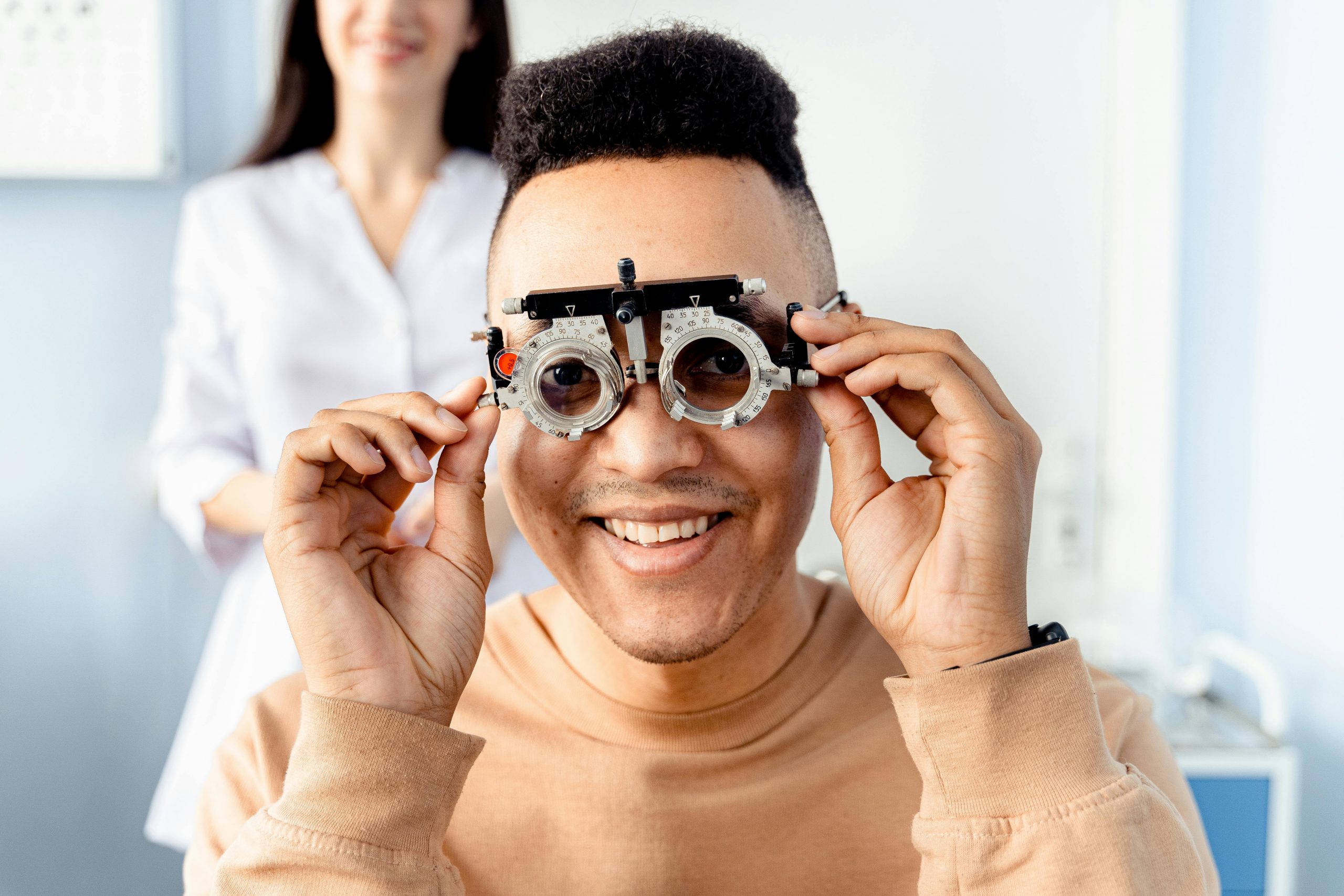
Custom contact lenses are specially designed lenses created to match the unique shape, vision needs, and eye health of each patient. At CustomEyes, we provide custom contact lenses in our Pearland and Memorial locations, offering personalized fittings for patients who need more precision, comfort, and clarity than standard contact lenses can provide.

While eyeglasses have been around since before the Renaissance, contact lenses represent a modern scientific achievement that requires careful evaluation and expert fitting. Although sometimes a nuisance, eyeglasses aren’t as potentially dangerous as contact lenses can be for your eye health.

Schedule Your Custom Contact Lens Exam

Different Lens Designs

Getting a new prescription for is important to ensure we capture an accurate measurement of your vision needs. At our clinic, our contact lens specialists in Houston will evaluate your eyes to determine the best solution, whether custom made contact lenses or standard soft lenses are the best solution for your needs.

An eyeglasses prescription is a helpful guide for a contact lens prescription, but we measure the variation in shape of each patient’s eyes for a contact lens prescription. Identifying the necessary lens power to correct a patient’s farsightedness or nearsightedness is the primary purpose of updating a contact lens prescription.

Other variations in the eye’s shape are also important for a good fit.

Differences between your left and right eyes sometimes require bifocal contact lens. These multifocal contacts simultaneously correct two refractive errors in a patient’s eyes. Sometimes bifocal contacts are too uncomfortable or don’t provide clear vision, so we prescribe monovision contacts. These contacts split the error correction between the left and right eyes.

Irregular cornea curvature can worsen an already-bad prescription by ineffectively spreading light onto the retina. Corneas like these require corrections for astigmatism or keratoconus (the latter in more severe cases).

With a copy of your prescription, you can also ask for an eyeglasses prescription.

However, not all contacts are of the same quality. Technological advances in contact lens manufacturing and efficacy have created possibilities for many different contact lens types. Those types can vary by the materials used or the functional design.


Are contact lenses not really your thing? Check out our monthly eyeglasses specials.

Different Contact Lens Materials

You can choose from multiple types of of personalized contact lenses, depending on your eye health and lifestyle:

  • Soft contact lenses offer the comfort of a soft, flexible lens. The hydrogel material gives soft contacts their pliable, comfortable structure. Soft lenses are the most common type of contact lens material for our patients. For patients needing a personalized fit, custom soft contact lenses can provide greater precision, enhanced comfort, and improved vision correction.
  • Extended-wear lenses are made of the same material as soft lenses, plus an added silicone element that increases breathability and motility. These are known as overnight contacts because sleeping in them isn’t potentially harmful for eye health.
  • Rigid gas permeable (GP) lenses are made of a hard, plastic material with microscopic holes that allow oxygen (gas) to pass to the eye. Generally, GP lenses offer many advantages, like increased breathability, sharper vision and longer durability. Nonetheless, GP lenses cost more and can be uncomfortable for some patients.
  • Hybrid contact lenses are a combination — the rigid GP lens with the hydrogel edges of a soft lens. This dual design offers better lens breathability and the comfort of soft lenses.

Choose Your Lens Type

Advances in contact lens technology affect the lenses’ design and materials. Contact lenses need to fit the wearer’s lifestyle, so take these factors into consideration:

  • Daily wear contacts are single-use lenses. Given their purpose, they’re one of the safest lens types because they don’t require maintenance or cleaning. Their thinner design and high water content mean the natural buildup of bacteria, lipids or proteins is less likely.
  • Monthly contact lenses require more maintenance and cleaning than single-use lenses. Longer-use lenses are thicker. Monthly contacts can present more opportunities for mishandling, which can harm a patient’s eyes.
  • Two-week contacts provide a middle ground in terms of flexibility, cost and maintenance. With the availability of newer, more breathable materials, two-week contact lenses are waning slightly.

What Our Complete Contact Lens Exam Tests For

During our comprehensive eye exams, optometrists cover numerous health factors. To ensure proper eye care for custom contact lenses, the CustomEyes team performs these tests:

  • Vision acuity test
  • Cover test
  • Internal eye pressure
  • Ocular motility for eye muscle capabilities
  • Color blindness
  • Eye coordination
  • Depth perception
  • Peripheral vision
  • Color vision
  • Internal eye pressure
  • Ocular refraction
  • Responsiveness to light

Contact Lens Fitting Process

At CustomEyes, our expert staff provides top-tier contact lens fittings in Houston. We take your personal medical history, evaluate your eye structure, and match you with the best custom contact lenses for your lifestyle.

There, our expert staff takes a personal medical history of your current prescription, current medications and any previous eye or vision conditions. This allows us to tailor a custom contact lens exam to meet your unique needs.

Contact us today to schedule a consultation with a contact lens specialist and explore our wide range of custom made contacts available right here in Houston.